 Tuesday at Camp Muir, two climbers departed in the morning hoping to climb the Ingraham Direct. The pair made it to 13K before turning around. They reported knee deep snow the entire way up the Ingraham Glacier. They also reported several crevasse crossings, most of which went smoothly. They stated that the bridges were in good shape and most were easy to cross. That said, one of the pair did take a crevasse fall at 13K... After a day of kicking steps in deep snow, the pair decided to descend after the crevasse fall.
Gibraltar Ledges was attempted on Wednesday by a soloist (carrying skis). He reported knee deep snow on the Cowlitz Glacier up to the beginning of the ledges. The snow on the Cowlitz was described as powdery, underneath a crust of varying thickness, but "thin" overall.
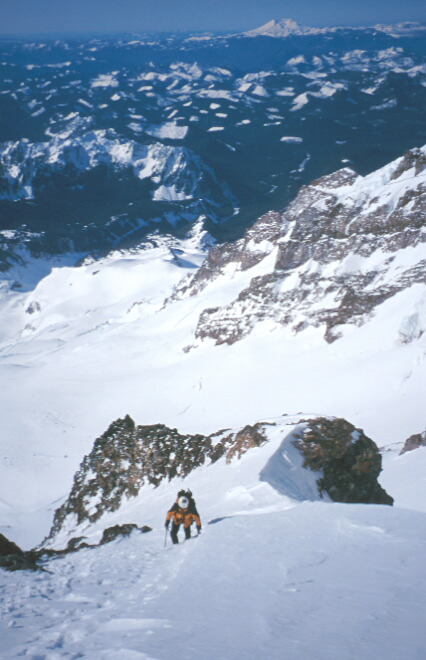
On the ledges, the climber experienced a lot of soft, sugary snow... Sometimes even waist deep. It took over 2.5 hours to traverse and climb the ledges. After pushing through what you get when you "open a bag of cane sugar," upward progress seemed futile. He turned around at 12,500 feet (about 3/4 of the way up the chute). It took over an hour to descend the ledges, as the footing was still quite challenging.
There is a boot path up the Muir Snowfield. The weather is supposed to be excellent this weekend.
Photo by Mike Gauthier, climber ascending Gib Ledges before the traverse and chute.
Tuesday at Camp Muir, two climbers departed in the morning hoping to climb the Ingraham Direct. The pair made it to 13K before turning around. They reported knee deep snow the entire way up the Ingraham Glacier. They also reported several crevasse crossings, most of which went smoothly. They stated that the bridges were in good shape and most were easy to cross. That said, one of the pair did take a crevasse fall at 13K... After a day of kicking steps in deep snow, the pair decided to descend after the crevasse fall.
Gibraltar Ledges was attempted on Wednesday by a soloist (carrying skis). He reported knee deep snow on the Cowlitz Glacier up to the beginning of the ledges. The snow on the Cowlitz was described as powdery, underneath a crust of varying thickness, but "thin" overall.
On the ledges, the climber experienced a lot of soft, sugary snow... Sometimes even waist deep. It took over 2.5 hours to traverse and climb the ledges. After pushing through what you get when you "open a bag of cane sugar," upward progress seemed futile. He turned around at 12,500 feet (about 3/4 of the way up the chute). It took over an hour to descend the ledges, as the footing was still quite challenging.
There is a boot path up the Muir Snowfield. The weather is supposed to be excellent this weekend.
Photo by Mike Gauthier, climber ascending Gib Ledges before the traverse and chute.

Friday, April 21, 2006
Gibraltar Ledges and Ingraham Glacier Direct Route Conditions
Two teams attempted these routes this week. Tuesday at Camp Muir, two climbers departed in the morning hoping to climb the Ingraham Direct. The pair made it to 13K before turning around. They reported knee deep snow the entire way up the Ingraham Glacier. They also reported several crevasse crossings, most of which went smoothly. They stated that the bridges were in good shape and most were easy to cross. That said, one of the pair did take a crevasse fall at 13K... After a day of kicking steps in deep snow, the pair decided to descend after the crevasse fall.
Gibraltar Ledges was attempted on Wednesday by a soloist (carrying skis). He reported knee deep snow on the Cowlitz Glacier up to the beginning of the ledges. The snow on the Cowlitz was described as powdery, underneath a crust of varying thickness, but "thin" overall.
On the ledges, the climber experienced a lot of soft, sugary snow... Sometimes even waist deep. It took over 2.5 hours to traverse and climb the ledges. After pushing through what you get when you "open a bag of cane sugar," upward progress seemed futile. He turned around at 12,500 feet (about 3/4 of the way up the chute). It took over an hour to descend the ledges, as the footing was still quite challenging.
There is a boot path up the Muir Snowfield. The weather is supposed to be excellent this weekend.
Photo by Mike Gauthier, climber ascending Gib Ledges before the traverse and chute.
Tuesday at Camp Muir, two climbers departed in the morning hoping to climb the Ingraham Direct. The pair made it to 13K before turning around. They reported knee deep snow the entire way up the Ingraham Glacier. They also reported several crevasse crossings, most of which went smoothly. They stated that the bridges were in good shape and most were easy to cross. That said, one of the pair did take a crevasse fall at 13K... After a day of kicking steps in deep snow, the pair decided to descend after the crevasse fall.
Gibraltar Ledges was attempted on Wednesday by a soloist (carrying skis). He reported knee deep snow on the Cowlitz Glacier up to the beginning of the ledges. The snow on the Cowlitz was described as powdery, underneath a crust of varying thickness, but "thin" overall.
On the ledges, the climber experienced a lot of soft, sugary snow... Sometimes even waist deep. It took over 2.5 hours to traverse and climb the ledges. After pushing through what you get when you "open a bag of cane sugar," upward progress seemed futile. He turned around at 12,500 feet (about 3/4 of the way up the chute). It took over an hour to descend the ledges, as the footing was still quite challenging.
There is a boot path up the Muir Snowfield. The weather is supposed to be excellent this weekend.
Photo by Mike Gauthier, climber ascending Gib Ledges before the traverse and chute.
Tuesday at Camp Muir, two climbers departed in the morning hoping to climb the Ingraham Direct. The pair made it to 13K before turning around. They reported knee deep snow the entire way up the Ingraham Glacier. They also reported several crevasse crossings, most of which went smoothly. They stated that the bridges were in good shape and most were easy to cross. That said, one of the pair did take a crevasse fall at 13K... After a day of kicking steps in deep snow, the pair decided to descend after the crevasse fall.
Gibraltar Ledges was attempted on Wednesday by a soloist (carrying skis). He reported knee deep snow on the Cowlitz Glacier up to the beginning of the ledges. The snow on the Cowlitz was described as powdery, underneath a crust of varying thickness, but "thin" overall.
On the ledges, the climber experienced a lot of soft, sugary snow... Sometimes even waist deep. It took over 2.5 hours to traverse and climb the ledges. After pushing through what you get when you "open a bag of cane sugar," upward progress seemed futile. He turned around at 12,500 feet (about 3/4 of the way up the chute). It took over an hour to descend the ledges, as the footing was still quite challenging.
There is a boot path up the Muir Snowfield. The weather is supposed to be excellent this weekend.
Photo by Mike Gauthier, climber ascending Gib Ledges before the traverse and chute.

Tuesday, April 11, 2006
Liberty Ridge - Spring Ascent
A team of 3 Midwest climbers set their sites on Liberty Ridge last week... and for the second reported time in 2006, climbers made it again to the summit of Rainier. Erik Beeler, Neal Mueller and Isaac Will pushed through deep snow, high winds, whiteouts, steep ice, 5th class rock and even a moonlit night so that they could top out of Mount Rainier's classic of line.
The wintry conditions took more out of the team than expected. In particular, areas of really deep snow became troubling and time consuming. They had intended to spend three nights on route, but needed FIVE and were forced to bivy near 13,000 feet.
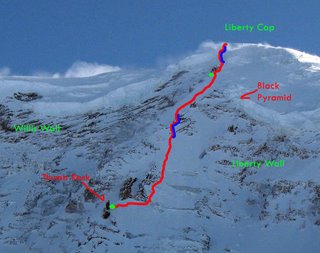 In this close up image of the upper route, green dots represent the high camps and bivies and the blue sections represent areas of difficulty or belays. It's interesting to note that the team took the far right variation out of Thumb Rock.
Neal made it clear that "some deep snow" was not going to thwart their summit efforts. A mix of Midwest pride and fortitude pushed the men through the exhausting conditions. And yes, they did wonder about avalanches...
They started late the 1st day and spent the night along the trail in the snow. The 2nd night found them near the access to the Carbon, 7,200 feet. It was up to Thumb Rock for the 3rd and 4th night. Isaac stated that the extra night was needed because,
In this close up image of the upper route, green dots represent the high camps and bivies and the blue sections represent areas of difficulty or belays. It's interesting to note that the team took the far right variation out of Thumb Rock.
Neal made it clear that "some deep snow" was not going to thwart their summit efforts. A mix of Midwest pride and fortitude pushed the men through the exhausting conditions. And yes, they did wonder about avalanches...
They started late the 1st day and spent the night along the trail in the snow. The 2nd night found them near the access to the Carbon, 7,200 feet. It was up to Thumb Rock for the 3rd and 4th night. Isaac stated that the extra night was needed because,
 In this close up image of the upper route, green dots represent the high camps and bivies and the blue sections represent areas of difficulty or belays. It's interesting to note that the team took the far right variation out of Thumb Rock.
Neal made it clear that "some deep snow" was not going to thwart their summit efforts. A mix of Midwest pride and fortitude pushed the men through the exhausting conditions. And yes, they did wonder about avalanches...
They started late the 1st day and spent the night along the trail in the snow. The 2nd night found them near the access to the Carbon, 7,200 feet. It was up to Thumb Rock for the 3rd and 4th night. Isaac stated that the extra night was needed because,
In this close up image of the upper route, green dots represent the high camps and bivies and the blue sections represent areas of difficulty or belays. It's interesting to note that the team took the far right variation out of Thumb Rock.
Neal made it clear that "some deep snow" was not going to thwart their summit efforts. A mix of Midwest pride and fortitude pushed the men through the exhausting conditions. And yes, they did wonder about avalanches...
They started late the 1st day and spent the night along the trail in the snow. The 2nd night found them near the access to the Carbon, 7,200 feet. It was up to Thumb Rock for the 3rd and 4th night. Isaac stated that the extra night was needed because, "As soon as we started to set up camp, my body started to let me know exactly what I had done to it... I threw up before I got in the tent, and... three more times before I could get some Power Gels and water to stay down. I didn't have a headache and I was not concerned it was AMS. The weather was not perfect and when we woke up at 0500. I said I could use another day to recover. They all agreed a rest day was in order so we stayed in the tent all day long."After a recovery, the team climbed a major portion of the upper route. The 5th night was pitched at a bivy site above 13,000 feet. At that camp, Issac described setting anchors into the rock for fear of either being blown or avalanched off the mountain. Thankfully, neither happened. They belayed two pitches of alpine ice (one was described as 15 fee of WI 4) to reach Liberty Cap. After finding a few crevasses the hard way between Liberty Cap and the summit, the team cautiously descended to Camp Schurman. They spent a final night in the hut, but only after digging it out. Somehow, the door had blown open during the winter and for the most part, the hut was filed with snow... The team intends to post a trip report on summitpost and cascadeclimbers. You can also find information on Neal Mueller's website. Successfully climbing Liberty Ridge is quite an achievement this time of year, congratulations and thanks for your help digging out the Camp Schurman hut! Also, thanks to Pandora for sharing her image here.
Liberty Ridge Climb in April
.0.jpg) Three climbers from MN climbed Liberty Ridge this week. I spoke with the team and have the initial report.
More details later today.
This photo of Liberty Ridge was taken a few years ago during the month of May. Photo by Mike Gauthier
Three climbers from MN climbed Liberty Ridge this week. I spoke with the team and have the initial report.
More details later today.
This photo of Liberty Ridge was taken a few years ago during the month of May. Photo by Mike Gauthier
Thursday, March 23, 2006
Abandoned Gear
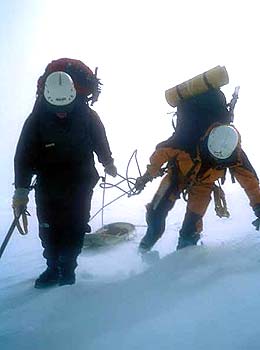 In the 05/06 winter, three separate climbing teams reported being caught in significant storms. Two were below Camp Muir, and one was higher on the Ingraham Glacier.
While getting lost or pinned down in a storm on Mount Rainier isn't that unusual given the time of year, it was interesting to note that all three teams retreated to snowcaves. Pure and simple, shovels are mandatory. And that means one for each person. One team said that they broke three of their shovels while digging. Thankfully, there were four of them!
These teams were helped by their size; two were 4-person, one was 5. It’s a lot easier to pull through a storm with extra people around. And as the storms relented, each team made their way back to Paradise without assistance, but not without some cost.
Two of the teams abandoned a significant amount of equipment; gear such as tents, bags, stoves and pads. Each stated that they could not retrieve all of the equipment because of the intensity of the storm and snow accumulation. Tents, for example, were nearly impossible to dig out. To them, it seemed safer to retreat; this is a tough decision to make.
It can’t be overstated, winter AND spring storms can be particularly fierce on Mount Rainier. If you’re pinned down and must abandon camp (high winds, snowfall, avalanche/icefall exposure), do all you can to retrieve at least your stove, pad, clothing and bag. One tip is to pack your pack before exiting the tent.
Though a rapid exodus to Paradise or Camp Muir may seem appealing given the current circumstances, it has also led to many notable accidents and fatalities. Caught on the mountain with only a shovel and few odds and ends is a downright brutal experience to live through.
Photo by Mike Gauthier
In the 05/06 winter, three separate climbing teams reported being caught in significant storms. Two were below Camp Muir, and one was higher on the Ingraham Glacier.
While getting lost or pinned down in a storm on Mount Rainier isn't that unusual given the time of year, it was interesting to note that all three teams retreated to snowcaves. Pure and simple, shovels are mandatory. And that means one for each person. One team said that they broke three of their shovels while digging. Thankfully, there were four of them!
These teams were helped by their size; two were 4-person, one was 5. It’s a lot easier to pull through a storm with extra people around. And as the storms relented, each team made their way back to Paradise without assistance, but not without some cost.
Two of the teams abandoned a significant amount of equipment; gear such as tents, bags, stoves and pads. Each stated that they could not retrieve all of the equipment because of the intensity of the storm and snow accumulation. Tents, for example, were nearly impossible to dig out. To them, it seemed safer to retreat; this is a tough decision to make.
It can’t be overstated, winter AND spring storms can be particularly fierce on Mount Rainier. If you’re pinned down and must abandon camp (high winds, snowfall, avalanche/icefall exposure), do all you can to retrieve at least your stove, pad, clothing and bag. One tip is to pack your pack before exiting the tent.
Though a rapid exodus to Paradise or Camp Muir may seem appealing given the current circumstances, it has also led to many notable accidents and fatalities. Caught on the mountain with only a shovel and few odds and ends is a downright brutal experience to live through.
Photo by Mike Gauthier
Monday, February 27, 2006
Sunset Amphitheater
 The Headwall Couloir...
A team of five climbers made a strong attempt on this remote and difficult route a few weeks ago. Here are a few images from one member's website; I'll attempt to summarize the trip. They decided not to post a report, but did share a few details with me.
The team first noticed that a major section of the
The Headwall Couloir...
A team of five climbers made a strong attempt on this remote and difficult route a few weeks ago. Here are a few images from one member's website; I'll attempt to summarize the trip. They decided not to post a report, but did share a few details with me.
The team first noticed that a major section of the 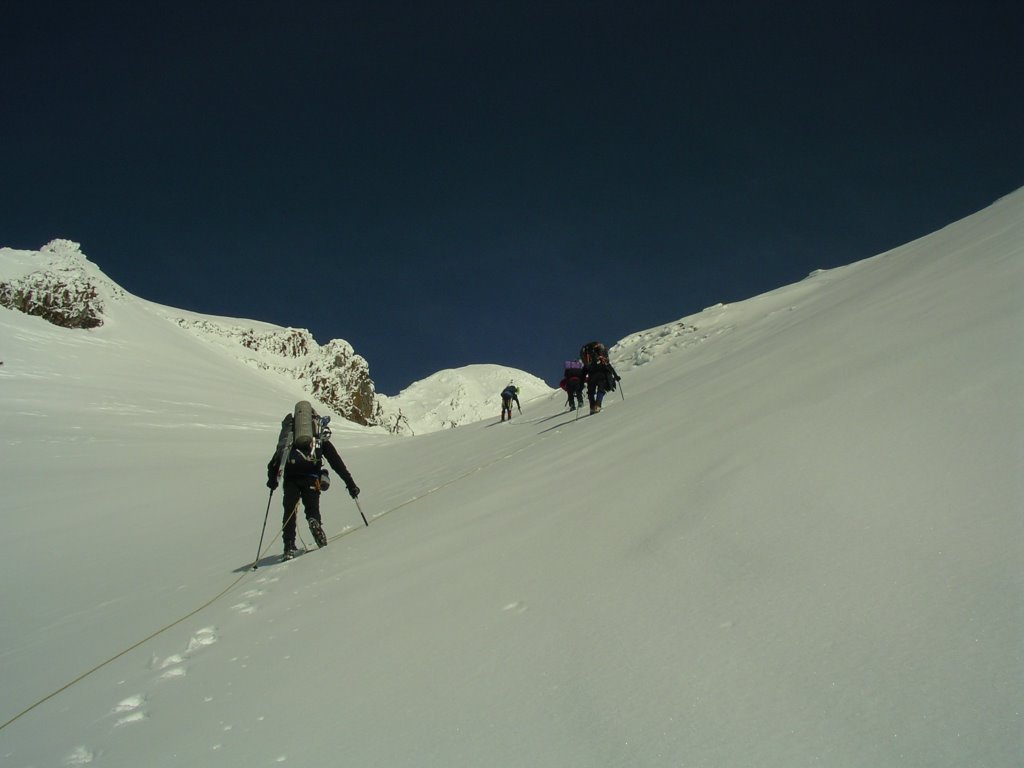
 Tahoma Creek Trail was destroyed below the suspension bridge/Wonderland Trail. Last fall, glacier outbursts from a heavy rain storm took out some of the westside road and Tahoma Creek Trail. The trail washout, in particular, was rather amazing. The original trail abruptly disappears into a creek bed of gravel, rock and boulders. What was once an old growth forest, moss, downed trees, dense vegetation, is now a creek bed with gigantic trees. The forest floor is buried. In all, about 1/2 mile of the trail is wiped out.
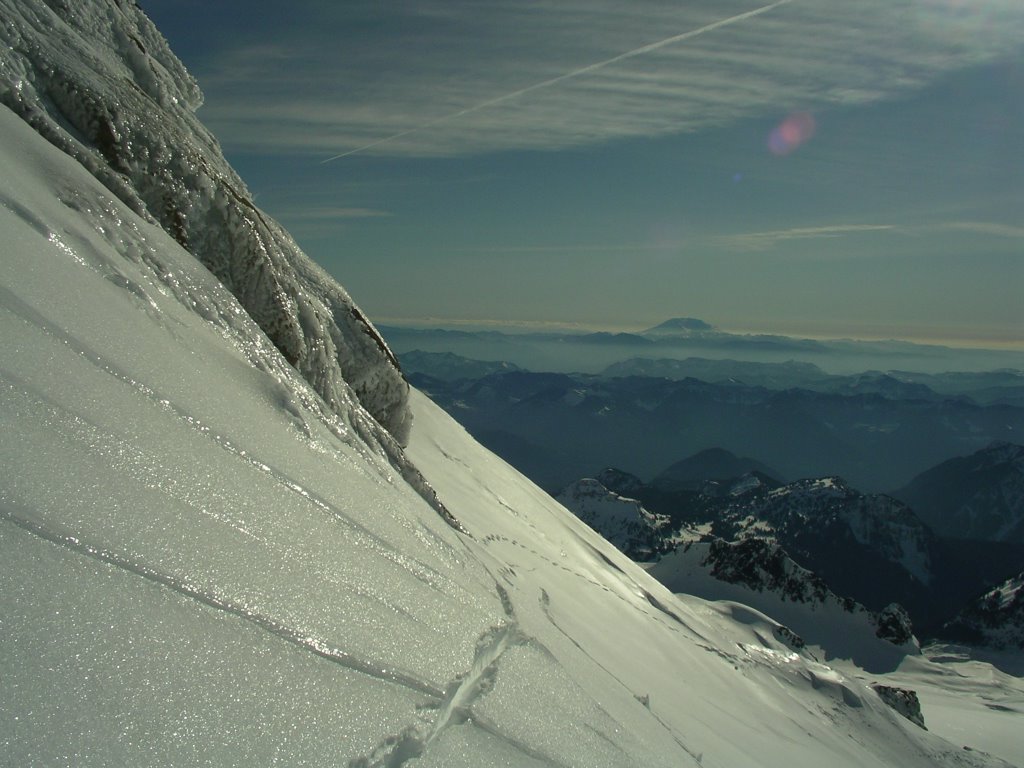
 As for the climbing route... The team reported a few problem, the first significant one being a dropped set of tent poles. This would make things difficult later on. Also, and maybe more importantly, they selected a route up St. Andrews Rock that cost them a day of travel... This exposure left them more vulnerable to the changing weather. And that's what happened, wind, snow, /12 a tent, and a snow shelter... It made for an interesting night.
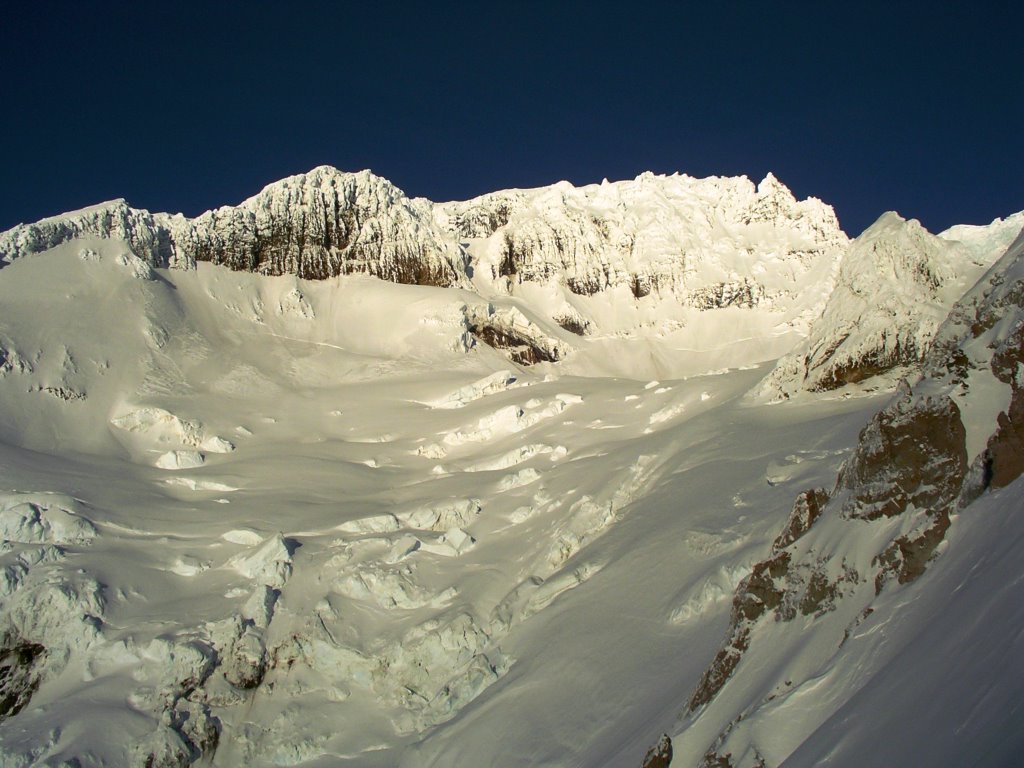 After losing the effectiveness of one tent, and a day of travel, the team reluctantly retreated with plans of returning. Despite not summiting, they felt the route was a go! Here is a closer picture of the Amphitheater and upper Puyallup Glacier.
For more information, see: a listing of climbs here. These photos are courtesy of Alexandre Mineev
After losing the effectiveness of one tent, and a day of travel, the team reluctantly retreated with plans of returning. Despite not summiting, they felt the route was a go! Here is a closer picture of the Amphitheater and upper Puyallup Glacier.
For more information, see: a listing of climbs here. These photos are courtesy of Alexandre Mineev

Monday, February 20, 2006
Cold Snap and Frozen Waterfalls
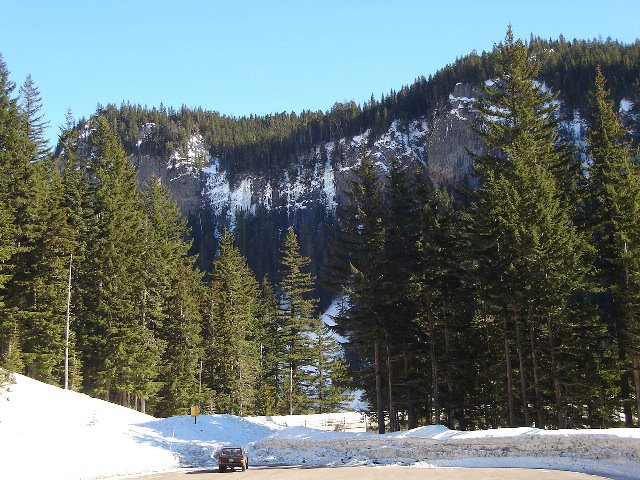 The mountain sustained several days of sub-freezing temperatures between Feb 16th-20th and the trend is expected to continue for the next six days.
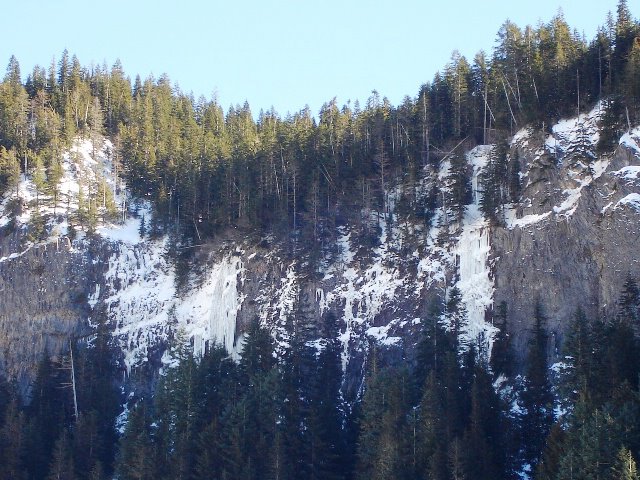
During that time numerous frozen waterfalls formed along the Nisqually-Paradise Road. Here are a few images... The approach is rather short, and the ice seems to be getting thicker each day.
The mountain sustained several days of sub-freezing temperatures between Feb 16th-20th and the trend is expected to continue for the next six days.
During that time numerous frozen waterfalls formed along the Nisqually-Paradise Road. Here are a few images... The approach is rather short, and the ice seems to be getting thicker each day.
 It was cold and blustery Friday and Saturday, particularly on the Muir Snowfield. I ran into a number of parties that turned back from their Camp Muir and/or summit plans because of the winds and temperatures. A few hardy groups did make it to Camp Muir on Saturday night, but those east winds and cold temps intensified with elevation and in the end, most parties lost their summit steam. And rightfully so, I recorded -7° F and a steady 20-25 MPH wind at Camp Muir.
On Feb 10/11th, Ted cleared a mountain of snow at Camp Muir. Thankfully, his handy work was still intact, as access to the Public Shelter, restroom, and emergency radio remained easy.
It was cold and blustery Friday and Saturday, particularly on the Muir Snowfield. I ran into a number of parties that turned back from their Camp Muir and/or summit plans because of the winds and temperatures. A few hardy groups did make it to Camp Muir on Saturday night, but those east winds and cold temps intensified with elevation and in the end, most parties lost their summit steam. And rightfully so, I recorded -7° F and a steady 20-25 MPH wind at Camp Muir.
On Feb 10/11th, Ted cleared a mountain of snow at Camp Muir. Thankfully, his handy work was still intact, as access to the Public Shelter, restroom, and emergency radio remained easy.
Subscribe to:
Posts (Atom)