 |
| Success Couloirs (Center) |
 |
| Kautz Ice cliff (Center Right) |
 |
| Russell Cliffs and Curtis Ridge (Willis Wall in the background) |
 |
| Willis Wall and Liberty Ridge |
 |
| Ptarmigan Ridge (Center) |

This blog is maintained by the Climbing Rangers for use by recreational non-guided climbers and skiers. Use these reports as a baseline but plan for changing conditions.
|
| Success Couloirs (Center) |
|
| Kautz Ice cliff (Center Right) |
|
| Russell Cliffs and Curtis Ridge (Willis Wall in the background) |
|
| Willis Wall and Liberty Ridge |
|
| Ptarmigan Ridge (Center) |


Even if someone skied the route a week prior, remember that we are in a highly dynamic environment that is changing at a fast rate: this results in quick route changes and new crevasses opening in a matter of hours, let alone days. Not only must you possess the skills necessary to navigate through heavily crevassed terrain, but anyone skiing the mountain must possess expert skiing abilities as any unplanned fall could have severe consequences.
Rangers are observing a marked increase in skier traffic on the upper mountain in recent years, with a decrease in the movement abilities of skiers and riders. This has coincided with an increase in accidents involving skiing. One constant observation that rangers are making is that the basic approach to risk management is often skewed in skiing parties.
The two biggest misconceptions about the risks involved with skiing on Rainier are:
Speed of Glacial Navigation on a Ski Descent: Since you may have more days on skis annually going downhill at a resort than you do walking downhill with crampons on, you may be under the impression that skiing down the upper mountain will be easier than walking. What this perception lacks to factor in is that when you are skiing, the same glacial navigation and snow bridge evaluation you had to perform on the way up the mountain has to happen at over double the speed on the way down! Rangers have seen many close calls with skiers approaching blind, convex rolls at speed -- just barely stopping before skiing straight into a crevasse. In one case, a skier was observed accidentally jumping a crevasse they did not identify. When managing open glaciers, slow is smooth and smooth is fast. So be sure to ski slow and in control, especially when you cannot see the whole line you are skiing.
Safety of Skis vs. Booting Uphill: It is often assumed that since skis spread one's weight out over a large surface area, they are a safer method of travel on glaciers. This may be true for flat valley glaciers, but while ascending on steep terrain, the opposite is often true. The extra weight and awkwardness of skiing or snowboarding makes the endeavor more challenging and requires more attention paid to risk management. Variable, steep surfaces with significant fall consequences are not the place to practice “high-stakes skinning”, especially if you are new to backcountry travel.
Individuals considering a ski attempt on Mt. Rainier should possess significant previous experience skiing on glaciers and at altitude. While no other Cascade volcano possesses the same degree of challenge for the ski mountaineer, it is strongly recommended to have experience skiing on other peaks like Mount Baker and Mount Adams before coming to Mount Rainier. Mt. Rainier has more substantial objective hazards and complex glaciated terrain than any other mountain in the lower 48. Combine this with the unpredictability of how high altitude will affect you, and having significant previous experience to draw on will provide a much higher safety margin on any ski descent of Mt. Rainier. A deep well of experience managing these hazards on less complex terrain should be developed before heading to Washington State's highest peak.
Other Safety considerations for planning a ski trip on Mount Rainier:
Team Selection
This is the most important factor to consider when planning a trip to Mount Rainier. The vast majority of terrain on Mount Rainier can be classified as “no fall” territory. Although ski falls may be common and insignificant in a ski resort, all falls on the upper mountain are serious. Simply losing an edge can easily cascade into an unstoppable slide into an open crevasse. Reverting to side-slipping or falling-leaf technique, rather than linked turns, can help maintain control of your ski descent. If anyone in your party has any doubt of their ability to safely ski the route, you must be willing to communicate that and revert to appropriate roped glacier travel techniques - this would include stashing skis low and continuing on foot. If you doubt your ski ability, consider hiring a professional to give you objective feedback in a more controlled environment such as a ski resort or less complex ski mountaineering objective.
Successfully completing a ski descent of Mount Rainier requires individuals and teams who are competent in a broad array of mountain skills. Mountaineering, glacier travel, rope techniques, navigation, and expert-level downhill skiing skills with a heavy backpack are the bare minimum.
Route Selection
There is no easy way to ski from the summit of Mount Rainier. All routes feature complex glacier travel, steep skiing, and long sections of no-fall terrain. Commonly attempted routes include: Emmons-Winthrop, Fuhrer Finger, Kautz Glacier, Success Couloir, and Ingraham Direct. There are many excellent ski descents on the mountain that minimize exposure to crevasses, ice and rock fall, and high altitude. Descents of the Muir Snowfield, Van Trump Snowfields, The Turtle, and Inter Glacier all serve as a nice introduction to the challenges of skiing on Mount Rainier.
One Day vs. Overnight Trips
An increasing number of teams opt for single day attempts; these require exceptional fitness levels. We see many teams that begin their attempt together but slowly get spread out across the upper mountain. This is unacceptable. It is crucial that team members remain within verbal and visual communication at all times. If one party member needs to stop or descend, the group should do the same. Do not leave anyone alone on the mountain. Consider a multi-day attempt so that you can begin your summit attempt rested and focused for the strenuous day ahead. Overnight trips also present better opportunities to time your descent for optimal conditions.
No matter which strategy your party chooses you must register for your climb and pay the climbing fee. More information on that process can be found here.
Weather and Avalanche
When signs of current or developing snow instability are present, the best course of action is to descend immediately from your current location rather than trying to outsmart the avalanche problem. It only takes a small amount of moving snow to knock you off your feet and push you into places that have serious consequences.
Snow Surface Conditions
This is probably the hardest variable to predict when planning a ski descent of Rainier. Snow conditions vary widely across aspect and elevation. The upper mountain rarely features smooth snow surfaces that could be defined as “good” skiing – it is commonly “survival skiing” up high. The surface above high camps is frequently a mix of breakable wind crust, very firm wind packed snow, ice chunks, sastrugi, and refrozen snow. Expect to ski “bad snow” for some or all of every descent.
Furthermore, it is rare that a ski descent does not require some down climbing. In many cases the decision to transition to crampons and ice axe for a short down climb can be a life-saving event. You must expect that you will need to take off your skis, rope up and climb down intermittently.
Glacier Conditions
As the season progresses, all potential ski descents become more challenging as crevasses open and more ice is exposed. The trend in recent years has been to attempt ski descents earlier in the season to help mitigate these hazards, though this brings increased risk of avalanches, challenging navigation, and more hidden crevasses. Regardless of when a descent is attempted, always ensure that you can see to the bottom of the slope you are on. Convex rolls are classic trigger points for avalanche's and often hide crevasses on their downhill side.
All parties on foot should be roped up to help protect against glacier hazards. This means that transitioning from skiing to booting (or booting to skiing) should be done after roping up and spreading out the team. The greatly reduced surface area of boots compared to skis greatly increases the likelihood of punching through a snow bridge into a crevasse.
Technical Rescue & Rope Considerations
All parties must be competent in crevasse rescue. Every member should wear a climbing harness at all times in the event of a crevasse fall. Carrying two ropes affords a greater safety margin in the event that the person carrying the only rope falls into a crevasse – this risk can be easily mitigated. Many teams opt to bring a single 60m rope, however carrying two ropes per team that are each 30+ meters increases rescue safety margins while having a commonly missed benefit: the ski quality for the party as a whole is increased as no one is skiing with the weight of a 60m of rope in their pack! Each party member should have enough supplies to construct a rescue anchor, rappel into and ascend out of a crevasse, and execute a haul system. All other mountaineering equipment should also be carried, including crampons, ice axe, helmet, navigation, and survival gear.
A ski descent of Rainier can be one of the most rewarding experiences for a competent party but it can quickly turn disastrous for the unskilled or unprepared. The fact that descending on skis is so much faster than on foot allows skiers to get off route and into problematic terrain all that more quickly. Proper planning and a high degree of caution is a prerequisite for a successful ski descent of the mountain.
Emmons-Winthrop
Consistent with our last blog post, the route climbed (red line) on 5/28 is very direct, going directly up and over two large cracks that have solid (for now) steep snow plugs. There was a notable crux at ~12,500’ that required climbers to front point and utilize axes in dagger position over a 20' section of AI 2/3. Beyond this, the route went directly to the crater rim, passing several zones of notably steep snow. This additional exposure can be avoided via a less steep option (green line) traversing out right on lower angle slopes underneath the icefall near ~13,200’, This would take climbers to the saddle between the top of Curtis Ridge and the summit. From here, one can gain the summit on the western facing, low angle slope from the saddle with minimal exposure compared to the direct route.

Snow surfaces from the summit to 12'500' were variable with intermittent sections of compact windboard, sastrugi, glacial ice and rough corn. This terrain is relatively steep, and a fall would not have a desirable outcome. Something to consider when skiing the Emmons is that while most glaciers have cross-slope cracks, the Corridor also has longitudinal cracks on either side!

Rangers visited the Success Couloir for an investigatory patrol. Rangers approached via Comet Falls, finding intermittent snow along the trail, which made for less than efficient travel. Continuous snow was found at ~5,000', where one can navigate up through the forest and continue toward the Success Glacier via Van Trump Park. A final, consequential traverse across well-covered snow slopes delivers prospective climbers to the ridge on the eastern edge of the Success Glacier at 8,000'. Upon arriving at camp, clouds lifted, and Rangers were able to assess conditions up high in greater detail.
Utilizing a monocular, Rangers observed deep runnels, chicken heads, and evidence of recent rockfall in Success Couloirs. Snow was discontinuous and would require climbing through several rock bands. Significant rock and ice fall events crossed much of the Success Glacier. Other ambitious skiers came through, ascending 300' into the couloir until they came to the the conclusion that they shouldn’t continue, reporting "heinous" conditions on the route. Ultimately, between this and conditions found in the Fuhrer Finger recently, it seems that the south side of the mountain is highly sun affected above 8,000'. Mid elevation slopes still hold excellent snow to about 5,800'.
That's the conditions report for this week! Hope to see everyone out there!
Below are aerial photos from the south side of Mt. Rainier over the weekend. These may be helpful for broad trip and route planning purposes.
 |
| Looking up the broad and well defined ridge of Success Cleaver |
 |
| Kautz Glacier |
 |
| Fuhrer Finger (the couloir with ski tracks) & Fuhrer Thumb |
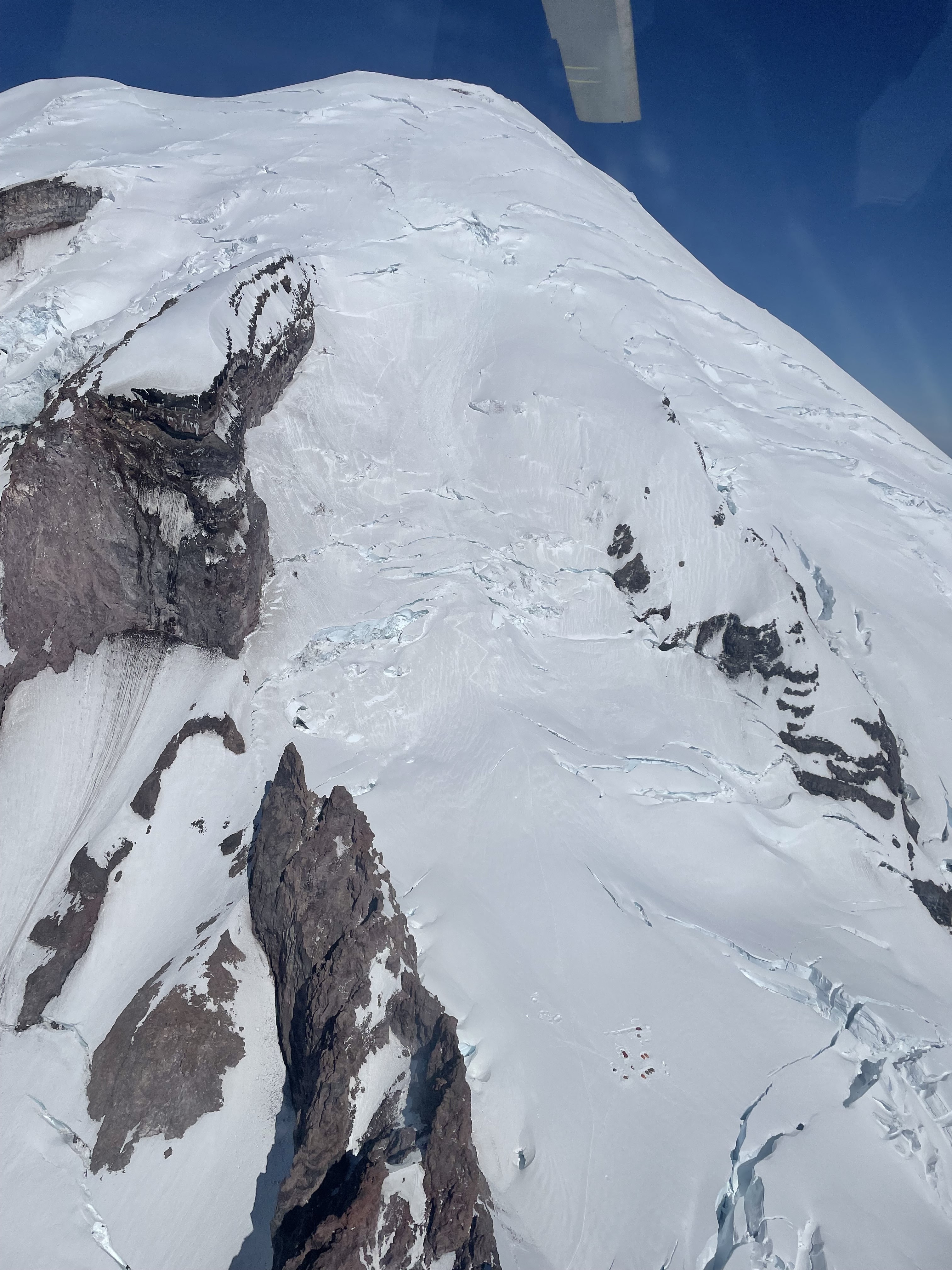 |
| Ingraham Direct. Photo taken above Cathedral Rocks. Note Ingraham Flats tents for reference |
 |
| Carbon glacier and Liberty Ridge |
 | |
| Curtis Ridge and the Carbon Glacier, viewed from the Russell Glacier |
 |
| The Carbon Glacier and North side of the mountain |
 |
| The Mowich Face and Edmunds Headwall |
 |
| Lower Sunset Ridge from the South Mowich Glacier |
 |
| The upper Puyallup Glacier |
 |
| A Climbing Ranger ascending early in the morning. Success Couloirs in the background. |


 |
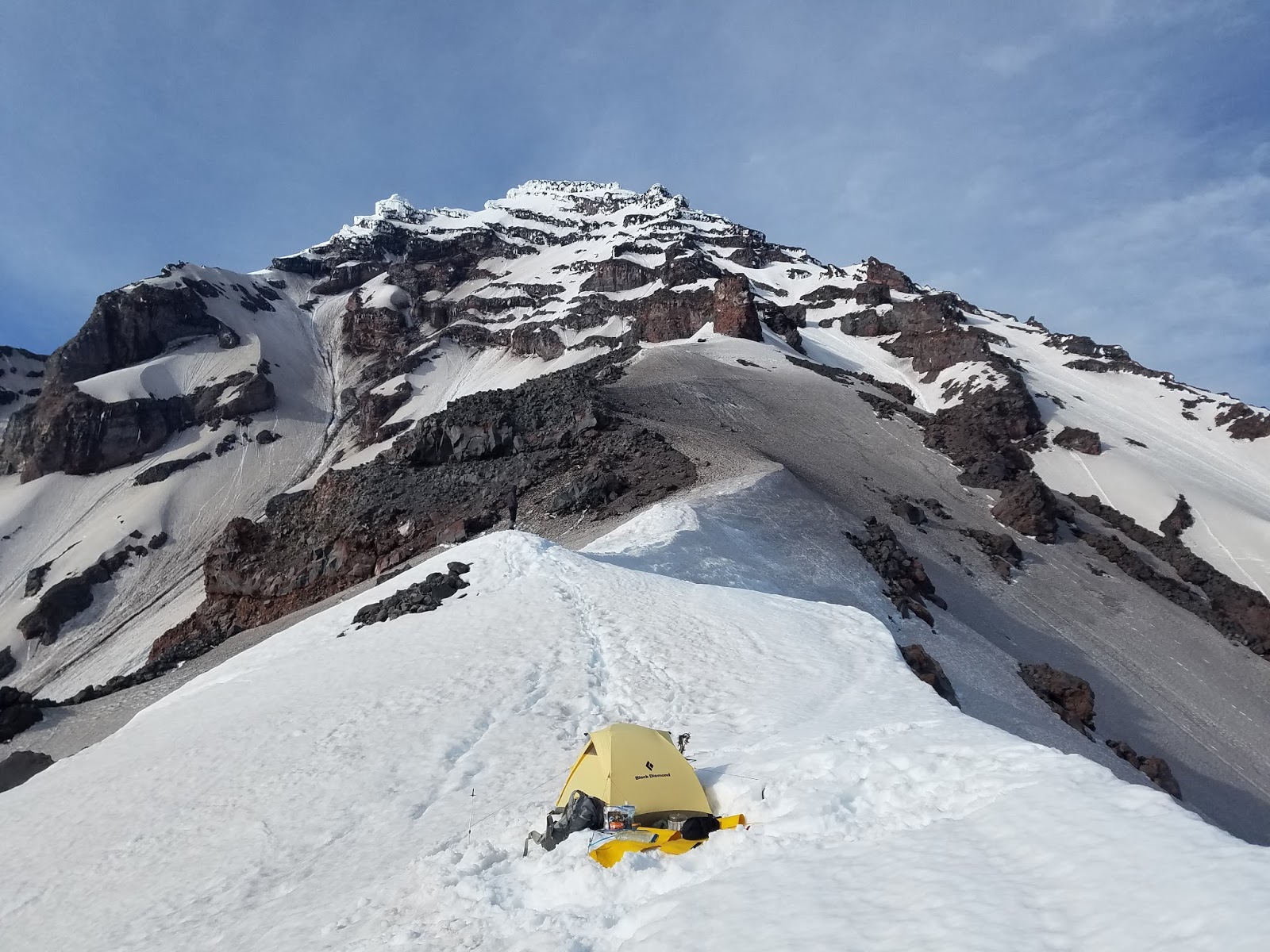
| Success Cleaver from Pyramid to the convergence with the Kautz Cleaver |
 |
| Lower Success |
 |
| Upper Success traverse |
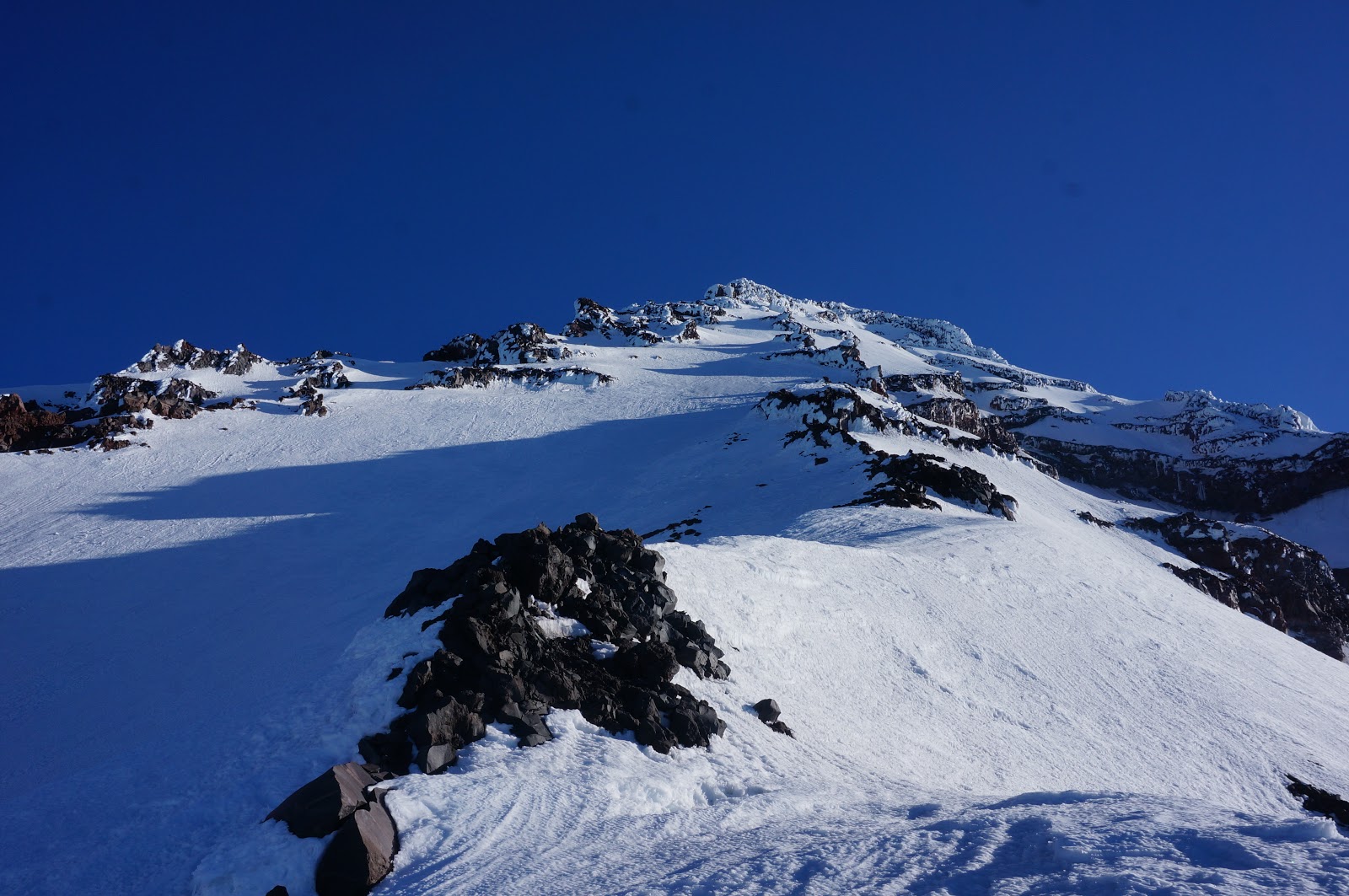 |
| Looking up the route from 11,400 ft. |
 |
| Ridge line melting out and breaking up as cornice pulls away from the ridge. Tricky navigation if you choose to stay on the snow. |
 |
| Route accross the Kautz glacier and up the couloir shown. 9,100 ft. camp shown as red square. |
 |
| Track log from camp to 13,000 ft. |