Monday, June 13, 2022

Avalanche Activity on the Emmons-Winthrop Route

Recent snow and wind has caused a significant avalanche cycle on the Emmons-Winthrop Route. This activity confirms that the upper mountain is retaining its winter character. Large crowns are visible from miles away, and the resultant slides are somewhere in the D3 size range. One slide put debris well below the elevation of Camp Schurman on the Winthrop Glacier. 

Photo taken from Camp Schurman on 6/11. Avalanche crowns are highlighted in red. 

Trying to forecast for snow stability in terrain as big and remote as the upper mountain of Mount Rainier is extremely difficult - due to hard-to-measure variables and loads of uncertainty. Traditionally climbers wait until warm spring temperatures stabilize the snow to avoid exposure to avalanches. Spring has yet to happen on Mount Rainier and the uncertainty of the winter snowpack remains. 

Photo taken 6/13 from Camp Schurman. Avalanche Crowns highlighted in red. 

Those attempting to climb Rainier in the near future will need to come prepared to do their own snow stability assessments and be open to the idea of turning around if conditions aren't right. Those who are looking for a more traditional summer ascent of the mountain will have to continue to wait for warmer temperatures. When spring does finally arrive and the snow stabilizes, we could have some amazing conditions for climbing and skiing Mount Rainier.

Tuesday, June 07, 2022

Upper Mountain Skiing and Snowboarding

The Upper Ingraham and Emmons Glaciers. NPS Photo

While it's not in the forecast yet, there will be an end to the persistent series of 'wet season-like' storms that have been pasting the mountain with snow. When the weather does stabilize we expect to see an influx of skiers looking to take advantage of what could be very good conditions. Please keep the following things in mind, though, before rushing to the mountain.

1) Give the snowpack time to stabilize

This has been an unusually wet Spring. In fact, May was the wettest it has been since 1948 and June is starting in much the same vein. That means the upper mountain has not had time for the winter snowpack to settle. Many of the climbing rangers think that the upper elevations look more like April than June. 

With the sun nearing the solstice that means when the switch to summer-like temps does come it will have a more rapid and pronounced effect than it would in April. The mid elevations have gone through a few very large avalanche cycles but above 10,000' this has not happened yet. Expect a period of highly unstable snow once the storms stop and the weather heats up. Give the snowpack some time to adjust to summer.

2) Just because you're on skis it doesn't make you safer.

It has become part of skiing culture that it is 'safer' to be on a glacier with skis/snowboard due to the increased surface area. While this may be true for a flat glacier with soft snow bridges it is not true for the upper mountain on Mt. Rainier. The surface near the summit of Rainier is typically very firm with lots of surface roughness and ice. The majority of the skiing/snowboarding accidents and fatalities are the result of falls while skiing. Poor surface conditions and a lack of skiing/snowboarding skill are often contributory factors to skiing accidents.

When talking to aspirational skiers/snowboarders at the high camps rangers are often surprised at the lack of experience people have before attempting a summit ski or snowboard descent. If you are not an expert level skier or snowboarder then it is considerably more dangerous for you to descend on skis/snowboard than on foot. Expect firm snow or ice about 12,000' where a fall while skiing can easily result in an out-of-control slide and a life threatening situation.

3) Climbing with ski/snowboard gear takes more effort and is slower.

The added weight and loss of efficiency when booting up Mt Rainier with skis/snowboard on your pack and boots on your feet should not be overlooked. AT boots are cumbersome to climb in and soft snowboard boots do not inspire confidence when crampon-ing. This should be factored in to your time plan and accounted for when evaluating conditions before beginning a descent on tired legs. Wind is another factor that will tire out a skier/snowboarder (when the skis/board is attached to the pack) faster than a traditional mountaineer.

4) Timing is everything.

Poor surface conditions can make a basic slope extremely dangerous and great conditions can make a steep run seem easy. Getting the timing right for a descent is one of the most important things a ski/snowboard team can do to maximize their margin of safety. Learning the patterns of when the sun, temperatures and wind all combine to make the surface good for a descent must be learned through experience. Relying on fixed time windows such as 'you always start a descent at XX:XX time' is a tell-tale sign of inexperience. The daily fluctuations in cloud cover, wind and temperature requires that a ski mountaineer be able to read the day and react accordingly.

Many would-be skiers/snowboarders will leave for their summit bid much later than the traditional mountaineers. This may be warranted when trying to give the snow time to soften during the day. But many teams underestimate the amount of time it will take them to reach the summit and thus put themselves in more danger by ascending during the hottest time of day. It's definitely preferable to wait for snow to soften from the top vs climbing through unstable snow and crevasse bridges. 

A ski/snowboard descent of Mt Rainier can be a wonderful and exhilarating experience. It can also be terrifying and extremely dangerous. It should never be taken lightly and for mountaineers with very little climbing and skiing/snowboarding experience it may not be at all appropriate in many conditions. 

Friday, June 03, 2022

Emmons-Winthrop 6/1

Independent parties, guided groups and climbing rangers all made successful summit climbs via the Emmons-Winthrop route on the 1st of June, 2022. A route from Camp Schurman following the Corridor was established with hard work and lots of trail breaking thru wind blown snow. This route ascends The Corridor and continues above it up to around 13,000' before trending right thru the bergschrund and continuing to contour to the crater rim. 

The Emmons glacier is coated in a thick blanket of snow for this time of year, and the need to end-run crevasses is minimal. Many may remember the cold and snowy Junes of a decade or more ago.  This season is very similar. 

There are multiple ways of climbing the Emmons currently and the main factor at play in the establishment of the current route is snow stability and avalanche danger. The upper mountain is continuing to receive snow and its being moved around by strong winds. When climbing in the coming weeks keep your winter avalanche assessment hat on and think twice before launching into steep, exposed or unsupported slopes with signs of a recent snow load.

A route to the summit.


View from Camp Schurman

Travel up to Camp Schurman has not been without challenges as well. The trail from White River to Glacier Basin is patchy with snow for the first 1.5 miles.  Recent snow and warming have made for numerous loose wet avalanches above glacier basin and this avalanche cycle has largely run its course in the 5-8000 ft range.. The snow pack is still in a state of settlement and parties without skis or snowshoes for flotation were finding themselves endlessly post-holing up the Inter Glacier. This will hopefully improve in the coming days, but we are a long way from a consolidated summer snowpack.

Wet Loose Avalanche activity above Glacier Basin.


Friday, May 27, 2022

Muir Snowfield and Ingraham Direct Update

For the holiday weekend, expect wintry conditions to persist on the mountain, especially above Paradise. Frontal systems moving through our area during the next couple of days will be unseasonably cold, wet and windy. Expect multiple inches of new snow each day Saturday and Sunday, with the highest concentration predicted to fall Saturday. The National Weather Service has issued a Winter Weather Advisory from 1PM Saturday to 5PM Sunday.
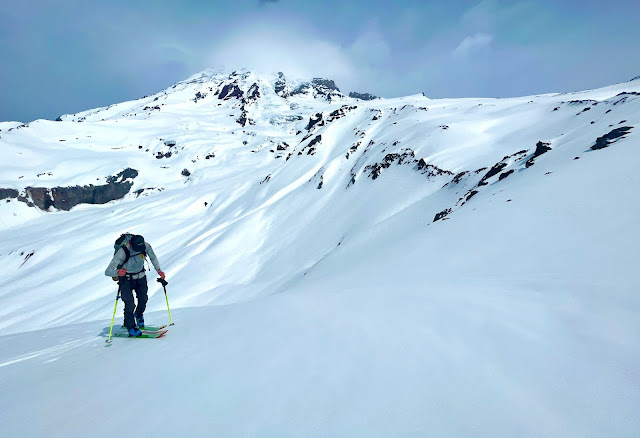

A ranger skins uphill near Panorama Point.


Of course it's still 100% snow from Paradise to Muir. It's a 'choose your own adventure' mashup of skin tracks and boot packs to the base of Panorama Point where everyone converges on the main chute to get up 'Pan Face'. Above that the boot pack trends NNE aiming towards McClure Rock and the Sugarloaf. This is what rangers and guides call the 'winter route'.

There are very few rocks exposed on the Muir Snowfield. Expect whiteout conditions, which can happen without notice despite any weather forecast. Please prepared to travel without visibility by recording a GPS track so you can get back to your starting point.

For a GPS device or cell phone to be useful for navigation the device must be and stay charged throughout your travels. Bring equipment to recharge if needed. Ensure the appropriate maps are downloaded for the area. If technology fails you, a map and compass can be a lifesaver. Below is a helpful NPS map not to be used as a topographic map, but it notes key features along the route, GPS coordinates, and the compass bearings to Camp Muir and back to Paradise. 


Camp Muir is very much still in winter conditions. NPS high camp workers, rangers, and the guides have all been teaming up to dig out the camp despite consistent new snow. As of 5/22/2022 there are five working bathrooms, 2 on the West side of camp, and 3 on the East side.

We are trying to discourage folks from urinating in bathrooms which operate on a conveyor system that is prone to freezing. Instead to dispose of urine waste on the snowfield side of camp and as far away from camp as possible. There are also no blue bag receptacles, currently, at Camp Muir. Please transport your blue bags down to Paradise for disposal.  Also, The public shelter has been reopened for normal use after being closed since 2020.
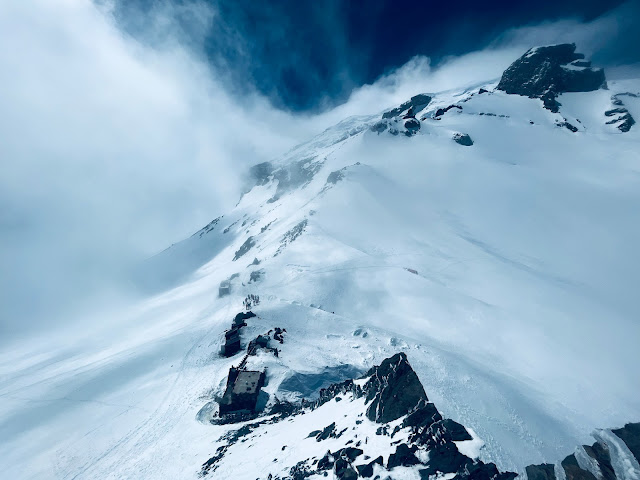
Camp Muir from Muir Peak

While climber success remains abnormally low, a few teams of guided parties and independent climbers have made the summit recently. Weather and heightened avalanche danger have been the main reasons for unsuccessful summit bides. We expect that to continue to be the case through the weekend and into next week.

Rangers have been busy opening the camp and have not yet been to the summit so information is a little thin on route conditions. The Ingraham Direct is 'in' but with several crevasses to traverse. With a winter storm advisory we can expect the exact route to change over the weekend but below is the track take by an independent team that went to the summit on May 23.


Please continue to use your winter mindset when preparing for a climb of Mt Rainier. Avalanche danger continues to outweigh most of the 'normal' hazards and if your team is not prepared to perform avalanche risk management please reconsider the timing of your climb.

Friday, May 20, 2022

Good Weather for the Weekend But Please Use Restraint

It looks like winter's icy grip is about to loosen for the weekend and that is cause for some celebration, but we're asking climbers and skiers to use some restraint before rushing to the mountain this weekend. Caution is advised due to the combination of two heightened risk factors:

1) A human-factor of Scarcity due to a lack of recent opportunities to recreate can create a self imposed pressure to finally take advantage of a nice weekend. And, the unusually cold and snowy spring we've been experiencing has thwarted many plans so it may be tempting to rush to take advantage of this weather window. Social media can also contribute to the fervor and increase the pressure you put on yourself to take on a big objective.  Stay true to your ability level and maximize your enjoyment! 

2) A Rapid Warming on a snowpack that is currently in a mid-winter condition. The climbing rangers have observed a widespread natural avalanche cycle with avalanches of up to size 3 (large enough to destroy cars and small buildings) within the past four days. This cycle will likely continue as the temperatures and solar input increases.  Guides have also been reporting sudden reactions on wind slabs above 10,000 feet.  There's no avalanche forecast for the upper mountain.  Use your judgement (of knowledge of your lack of experience to make a good judgement) to know when to turn around. 

During the past few good weather windows we have had several human triggered avalanches in the Nisqually Chutes and one prolonged rescue high on the Kautz Glacier. All of these incidents were a direct result of groups trying to 'squeeze-in' their objective during a break in the weather and could have been avoided by taking a tactical pause and assessing conditions objectively. 

So that's what we're asking the climbing and skiing community to do, collectively. Slow down, take a breath, talk to your partners and communicate with each other about the risk you are taking.  There's an above average and seemingly deep snowpack, and we should be climbing and skiing in great conditions well into the summer.   We want folks to enjoy, but be able to return to the mountain!

NPS/Waterfall Photo

Sunday, May 15, 2022

April Showers.. and May Storms!

It's been an unprecedented stormy start to the summer on Mount Rainier.  Prepare for full winter conditions for any adventure in the park this May.  Not much to report conditions-wise since weather has been shutting most of the climbing and skiing down.  Use caution when entering onto steeper slopes on the upper mountain - the snow pack hasn't transitioned to a regular spring diurnal pattern yet, and there could be hazardous conditions with all of the new snow.  

The Paradise Wilderness Information Center (PWIC) is already open on weekends - come on up and register in-person!  Self-registration is still in effect during the weekdays until May 27th.  After May 27th the PWIC will be open everyday through the end of the climbing season in September.  Paying the Climbing Fee and obtaining a Climbing Permit is required for all climbers and skiers who journey above 10,000 feet or onto a glacier - even folks doing a single-push style ascent.

Rangers were able to get up in the helicopter for some aviation training and snapped some photos of the upper mountain.  See below for some photos taken May 10th and 11th.  We're excited for more stable weather patterns and a bit more sunshine - and excited to see everyone up on the mountain soon!