Wednesday, September 28, 2016

Winter Season Transition

The last week of September is the last week of guided climbing trips on Mount Rainier for the season.  Guides will be pulling out the fixed pickets, wands, and ladders that they worked hard to maintain all summer long.  With colder temperatures, larger storm cycles, and no route kicked-in to the summit, winter conditions have arrived.

The Climbing Information Center also closed for the season this week.  Climber registration is still mandatory, but can be done in-person at the self-registration kiosk when you arrive.  See the Permits and Registration page for more info. 

There's still lots of road construction going on inside the park.  Please read signage and make sure to park your car in the appropriate location - especially if you're planning to be out overnight.  Freezing levels for early October are forecast to be around 5000 feet.  Hopefully we'll be skiing right out of the parking lot soon!

To illustrate the point, here is a graph of the 5-year average number of climbers per week.  The interesting thing to note is that we've seen a slight shift of the climbing occur over the last couple of years.  The season start a week or two 'earlier' than it did 10 or 20 years ago.  The end of the season also begins to wind down faster than it did historically.  The graph shows climbers registering for the Disappointment Cleaver route only.

Monday, September 05, 2016

Climbing Information Center Weekends Only


September 17th

Another beautiful day after the storm!  Yesterday was a bit blustery as the storm delivered a solid blow (70mph at Muir) as well as heavy rain (2.4 inches at Paradise).  For the skiers in the crowd, the freezing level (about 11,000' elevation) unfortunately resulted in more rain than snow on the Muir Snowfield, but winter may be back again next week!  For the climbers, the heavy rain and relatively high freezing level  resulted in a hard frozen layer for much of the mid mountain.  As the storm cooled, it eventually transitioned to snow.  Conditions like this make for more challenging footing and self-arrest.  While it's unclear just how high the frozen layer may exist, climbers should be prepared for much more difficult climbing over the next few days, until either another snowstorm buries the frozen layer, or it warms up enough to thaw things out.  Regardless, it's beautiful up here now with a new dusting of white offset by all the fall colors!
Climber Self-registration Kiosk
Now for some logistics...  The Climbing Information Center will only be open during the weekends in September.  We close during the weekdays due to low volume, but open back up Saturday and Sunday for business - 08:00 to 16:30.  Swing on in and say "hello" before heading out on your adventures if you visit on the weekend.  Climbers can self-register at Paradise when the Climbing Information Center is closed.  There's a kiosk with all the instructions to get you a climbing pass (if you still need one this year) and to fill out a permit/check-out card.

Parking at Paradise will also change in September due to a paving project.  Here's the gist: if you want to park overnight, please park in the Paradise Picnic Area or along the Paradise Valley Road.  See this press release for further details and a helpful map!

Thursday, September 01, 2016

Summer flowers fade to Fall color

September 1st 

A crisp morning sunrise, a stroll through the woods, sweaters and hot cocoa.  Thoughts of fall are in the air and soon the color show will begin. For many fall is a time of reflection. A time when we slow down, take in the view, and remember what we have accomplished. A time to sit and watch the landscape become a painted mosaic of vibrant color. 

Fantastic color in the paradise area fall of 2015

Mount Rainier is known for its amazing landscape displays of which some of the most spectacular are fall color. Labor day weekend marks the beginning of that change from summer to fall. This year Labor day weekend will hold some of those familiar fall notes with cooler temperatures, a chance of rain, and new snow on the upper mountain.

Much of the wildlife will be out about preparing for the winter season ahead. Please remember to not feed the wildlife and stay on the marked paths. Warm clothes, gloves and hats should be part of every visitors outfit while enjoying the park this time of year. The park is still seeing a far amount to visitation from hikers and climbers so don't forget to come in early for your backcountry camping permit. "Find your park" this labor day weekend!


Monday, August 08, 2016

Summer Weather Forecasts vs. Winter Weather Forecasts

Weather is one of the most important factors when you consider climbing Mt. Rainier.  Usually, July and August tend to be reliably good weather and most folks experience favorable climbing conditions during this period.

This year, the weather has been predictably less good.  Not bad?  Well, there have been bad days, but many of the predicted poor weather periods have been somewhat less intense than what many of the forecasted models have indicated - or at least how I would interpret them in the winter.

Last Monday, because of the models and forecasts, I scrubbed my planned trip to Camp Schurman thinking it was going to be poor weather.  It ended up being good enough to get up to Camp Schurman easily.  I should've gone.

So I thought I'd show some of the forecast tools I use, and offer show what the actual conditions are compared to what the models currently say.  This may help us interpret them.

First of all, I look at the UW MM5 WRF-GFS 36km 500mb Temp/Pressure/Winds model.  Here.  The model for this hour looks like this:


This has been a fairly typical weather pattern this summer.  Low pressure centers have been developing in the Gulf of Alaska and tracking down the BC coast to end up right over western Washington.  This is generally bad and brings cool, moist, and unstable air to the area.
 
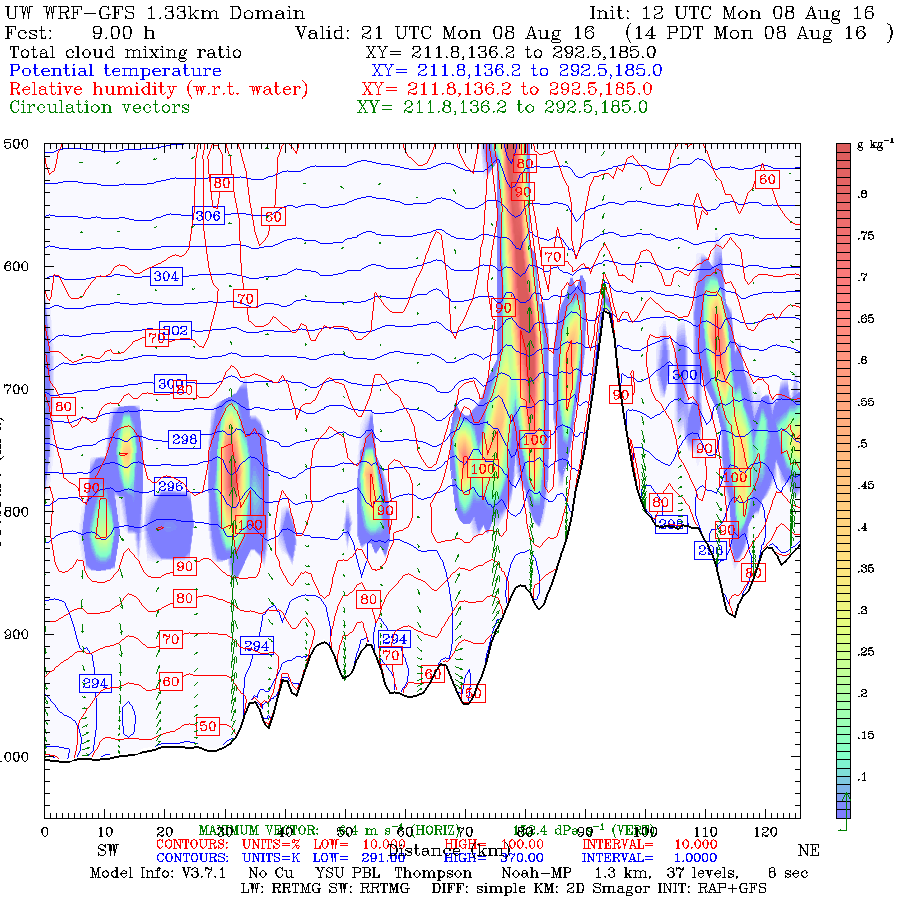
Next, I look at the UW WRF-GFS 4km Profile for Mt. Rainier.  Here.  It is a vertical cross section of the atmosphere.  This is what it looks like for the current forecast period:


The elevational profile of this graph is roughly from 0 feet to around 16,000 feet.  The rainbow colors are the presence of clouds.  So currently, at Camp Schurman, I would be looking at the right part of this picture, near what looks like a 'peak'. 
 
Next I like to cross reference these models with a different view of the same model inputs, the point data meteograms from the NWS.  Here.  This is what it looked like for this forecast period:
 
 
You can see right now that we are 'peaked' for precipitation and cloudiness (middle graph / brown and blue lines respectively).  The bottom graph indicates lightning!
 
The temperature / winds aloft forecasts was for calm winds.  Here.  I think this was probably the most important forecast component.  High winds in the forecast would've made things much more difficult and hard to manage myself.
 
What did I get on the way up this morning?
 
At 08:30 in White River, I had mostly cloudy skies, with a few sun breaks - all the way hiking in to the toe of the Inter Glacier at 7600 feet.  It began to snow lightly at first, then moderately.  Winds, from the north at 5-10 mph.  Snow level was about 8000.  It pretty much stayed like this all the way to Schurman.  It wasn't bad, at all.  Here's what it was like in Glacier Basin:
 
Here's a picture of what I'm looking at at Camp Schuman currently:
 
Here's a picture of the Camp Muir webcam, right now:
 
 
Conclusion:
 
Yes, the visibility was reduced to 200 yards.  Yes, I got a little snow on me.  But it was generally a good hike up!  If you have a GPS and can use it like a boss, or are experienced with a map and compass and are prepared (dressed) for snow falling, this isn't horrible weather to navigate in.  The guide services were in the area with me (I heard them, but seldom saw them) and made it up where they are currently digging tent platforms.  So the guides had a decent ascent up this morning, too.
 
In my experience, the weather forecast resources are pretty right on.  However, I'm often reminded that the summer softens, somewhat, the blow of the hammer of the gods.  In the winter, this forecast would likely have deterred me, wind or no wind.

** Update ** Plus, I just heard that RMI summitted today.  So....
 
I'm glad I came up today!
 
- Stefan
 

Tuesday, July 26, 2016

Late-July Prime Time

Busy Weekend at Camp Muir
It's that time of year again!  Summer weather has arrived with the hottest day in July predicted to be this upcoming Friday.  The two standard routes on either side of the mountain are still in great shape (but changing daily due to the hot weather).  And the daylight still lasts for over 15 hours (sunrise around 05:30 and sunsets around 21:00).  Climbing conditions are great!

Climbing early is important on these hot sunny days.  Snow bridges across crevasses weaken, seracs fall more often, and rocks frozen in place melt out during the middle of the day.  Try to be off the hazardous parts of the routes by noon.

Another tip for this time of year is to climb during the middle of the week.  Weekends can be crowded, and the opportunity of experiencing some "solitude" of climbing high in the alpine zone can be tough to get.  Plan your trip around the middle of the week for less crowds, quiet camping, and less jams on the route.  See you on the mountain!

Friday, July 08, 2016

Weather Windows

What is the weather doing on Mount Rainier? The age old questions that is on everyone mind when they come to climb the mountain, or is it? Many climbers plan months in advance, travel long distances, and sacrifice many other things to make their one trip to climb the Mountain. No matter how much planning goes into a trip their are always those unexpected obstacles we can't control like the weather. So what are you going to do about it?
Early Spring Conditions on Mount Rainier
There are so many weather tools out their today that provide us with the latest and greatest forecast, giving hour by hour in-depth information, but many of us don't know how to read or have the time to learn how to interpret these fancy graphs and flow charts.  So many climbers just ask the expert when is the best time to climb while they are here on their trip. What is my weather window? The new age question climber want to know.
So what is a weather window and how does it relate to climbing Mount Rainier? Many new aspiring mountaineers have preconceived ideas of what this may encompass. When do I start? How many hours? What is my turn around time? All good thoughts but in the grand scheme these questions are small picture thinking.  Weather windows at Mount Rainier should be measured in days not hours. The vast majority of people attempting a climb will take 3 days, and on the summit day from a high camp will take most of a day (8-14 hours) to complete.  Big picture high pressure vs. low pressure weather patterns are important to pay attention to. High pressure weather systems (called ridges) will provide you with the best weather window for making a successful climb. Climbing during a low pressure weather systems (call troughs) can have its successes but can be limited and challenging in possibly hazardous conditions.
Make sure to check the synopsis paragraph on the Mount Rainier Recreational Forecast
It will give you best up to date big picture view of what is happening at Mount Rainier and the surrounding area.